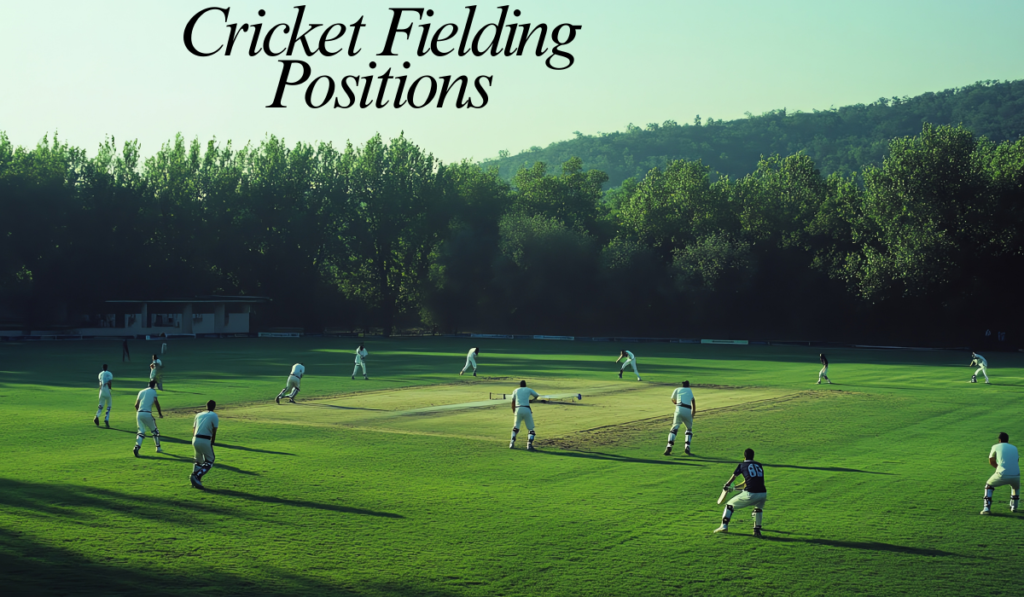

Fielding is the most prestigious part of cricket. When a draw is not possible, a strong batting side can score runs and an effective bowling lineup can claim wickets but without similarly functional fielding, a team will struggle to win games. Cricket Fielding Positions determine the player who field at those positions while stopping runs and taking catches on the ground to pressurize batsman.
Fielding positions in cricket are not fixed. They vary according to match conditions, type of bowler, the batsman’s strengths and the match situation. In Test cricket, you put fielders in place to take wickets; in T20 games, the primary objective is to prevent boundaries.
This post describes cricket fielding positions in easy to understand words, even a freshman at this game will have a clue where every fielder is placed and why.
What Are Cricket Fielding Positions?
Fielding positions in cricket are the specific locations on the field where fielders are stationed.
These names are based on:
- Direction (off side or leg side)
- Region from the batsman (close, inner circle, deep)
- Angle from the pitch
Each position has an obvious purpose, bringing one of catching edges, stopping singles, saving boundaries or intimidating the batsman closest to it.
Understanding the Cricket Ground Layout
To begin with the that, one must first know how does the ground look.
Off Side and Leg Side
- Off Side: The area in front of the batsman’s body (left side for a right-handed batsman)
- Leg Side (On Side): The side of the batsman’s body behind him
Inner Circle and Deep Field
- Inner Circle: Closest area to the pitch, particularly used for saving singles
- Deep On: Near the rope -used mostly for stopping 4s and 6s.
Major Categories of Positions in the Game of Cricket
There are four categories of cricket fielding positions:
- Close-in Fielding Positions
- Infield Positions
- Outfield (Deep) Positions
- Specialist Fielding Positions
Close-In Cricket Fielding Positions
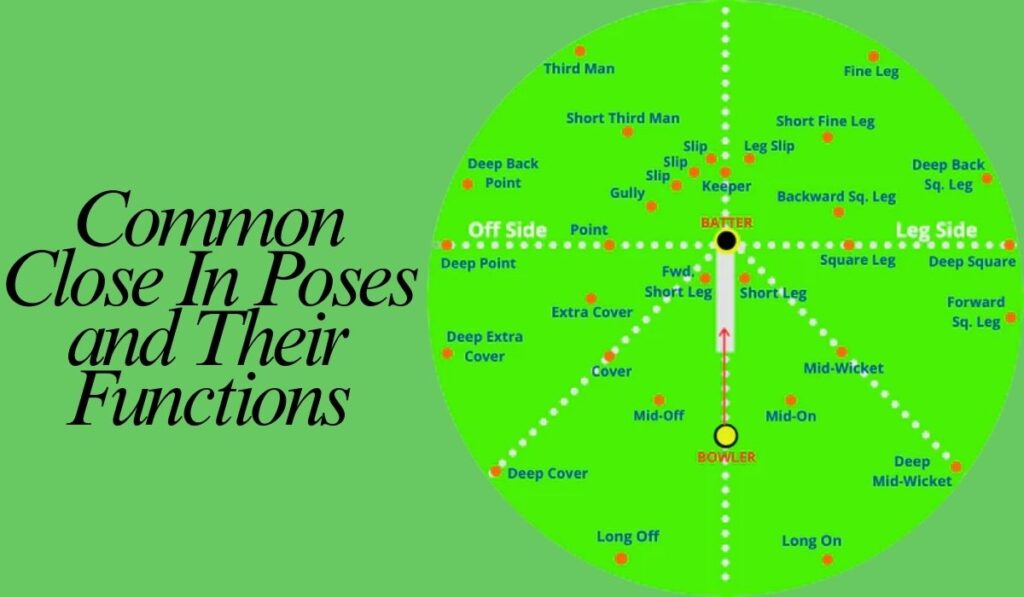
These positions are extremely close to the batsman and primarily employed in Test cricket when taking fast catches.
The Most Common Close-In Poses and Their Functions
| Position | Location | Main Purpose |
| Slip | Next to the wicketkeeper on off side | Catch edges |
| Gully | Behind point on off side | Catch thick edges |
| Silly Point | Very close on off side | Catch soft defensive shots |
| Short Leg | Close on leg side | Catch bat-pad chances |
| Leg Slip | Behind short leg | Catch leg-side edges |
High speed in close-in cricket fielding is needed for reflexes and courage because the ball comes out very fast.
In-field Cricket Fielding Positions (Saving Doubles)
These spots are inside of the inner circle and prevent runs too easily.
Important Infield Positions Explained
| Position | Side | Role |
| Point | Off side | Stop square cuts |
| Cover | Off side | Stop cover drives |
| Mid-Off | Straight | Stop straight drives |
| Mid-On | Straight | Stop on-side drives |
| Midwicket | Leg side | Stop flicks and pulls |
| Square Leg | Leg side | Stop leg-side shots |
In ODIs and T20s infielders are very important in controlling the field.
Read More: Royal Challengers Bengaluru vs Kolkata Knight Riders Timeline
Outfield (Deep) Cricket Fielding Positions
These are the fielders that are around the boundary to prevent fours and sixes.
Deep Fielding Positions Table
| Position | Side | Used When |
| Deep Cover | Off side | Against strong cover drives |
| Deep Point | Off side | Against cuts |
| Long-Off | Straight | Big hitters |
| Long-On | Straight | Lofted shots |
| Deep Midwicket | Leg side | Pull and slog shots |
| Deep Square Leg | Leg side | Sweep and pull shots |
| Fine Leg | Leg side | Glances and edges |
| Third Man | Off side | Edges past slips |
T20 and ODI: Deep fielding positions are also widespread in T20 and ODI cricket.
Wicketkeeper: The Most Important Fielding Position
wicketkeeper A specialized fielder that stands behind the stumps.
Responsibilities of the Wicketkeeper
- Catch edges
- Make stumpings
- Stop byes
- Guide field placements
A sharp grepper can add bite to the spinners and close catchers.
Cricket Fielding Positions for Different Formats of Cricket
Test Cricket
- More close-in fielders
- Focus on taking wickets
- Slips and short leg are in place
One Day Internationals (ODIs)
- Balance between attack and defense
- Combination of infield and outfielders
T20 Cricket
- More deep fielders
- Focus on stopping boundaries
- Very few close-in positions
Read More: Sunrisers Hyderabad vs Delhi Capitals Timeline / Kolkata Knight Riders vs Mumbai Indians Timeline
How Captains Decide Cricket Fielding Positions
Cricket fielding positions selection by the captains are based on :
- Batsman’s strengths and weaknesses
- Bowler’s style (fast, swing, spin)
- Match situation
- Pitch condition
For example:
- Against a swinging fast bowler, slips are added
- When a spinner is on, the fielders are positioned around bat.
Importance Of A Good Fielding In The Modern Game Of Cricket
Modern cricket demands high-quality fielding. One missed catch or fumble is the match for you.
Benefits of good fielding:
- Saves 20–30 runs per match
- Creates pressure on batsmen
- Supports bowlers mentally
Athlete Fielders Teams like India, Australia and England tend to prioritize athletic fielders.
Mistakes in Fielding Positions In Cricket.
Many novice teams fall into this trap:
- Too many fielders on one side
- Poor communication
- Slow movement between positions
- OP wrong way to position a paticular batsman
All these deficiencies can be avoided with a proper fielding position in cricket.
Tips to Improve Understanding of Cricket Fielding Positions
- Watch live matches carefully
- See how the field changes for each batsman
- Practice with diagrams
- Learn the fundamental naming logic (the direction + its distance)
Attacking Fielding vs Defensive Fielding
| Type | Purpose | Example Positions |
| Attacking | Take wickets | Slips, silly point |
| Defensive | Stop runs | Deep cover, long-on |
Great teams know when to storm and when to shantian.
Read More: Sunrisers Hyderabad vs Rajasthan Royals Timeline / Afghanistan National Cricket Team vs Australian Men’s Cricket Team Timeline
Why Field Setting is Important in Cricket at all Levels
Local cricket to internationals, specific fielding positions in the game of cricket:
- Improve team coordination
- Reduce pressure on bowlers
- Assist in teaching young players tactical thinking
Proper placement even matters during school and club cricket.
Conclusion
What are cricket fielding positions? Knowing where each fielder stands and why helps players, captains and spectators enjoy the game better. Whether Test cricket with its attacking slips or T20 cricket with its deep boundary riders, there is a role for every position.
Cricket fielding positions can be learned step-by-step and even a common man can understand the logic behind them with just a little commitment.
FAQs On Cricket Fielding Positions
Q1. How many positions are there in cricket fielding?
There are over 30 commonly used cricket fielding positions, although not all of them have distinct names.
Q2. What is the position that’s closest to batsman freelding?
Silly point and short leg are some of the closest fielding positions.
Q3. Do cricket fielding positions apply for ODI, T20 and Test?
No Fielding positions vary based on Test, ODI or T20 format.
Q4. What is the role of slips in Test cricket?
Slips help snare edges when the ball moves off the seam after pitching.
Q5. Can the field change position during an over?
Yes, captains are allowed to change the fielding positions of cricket in between deliveries.